
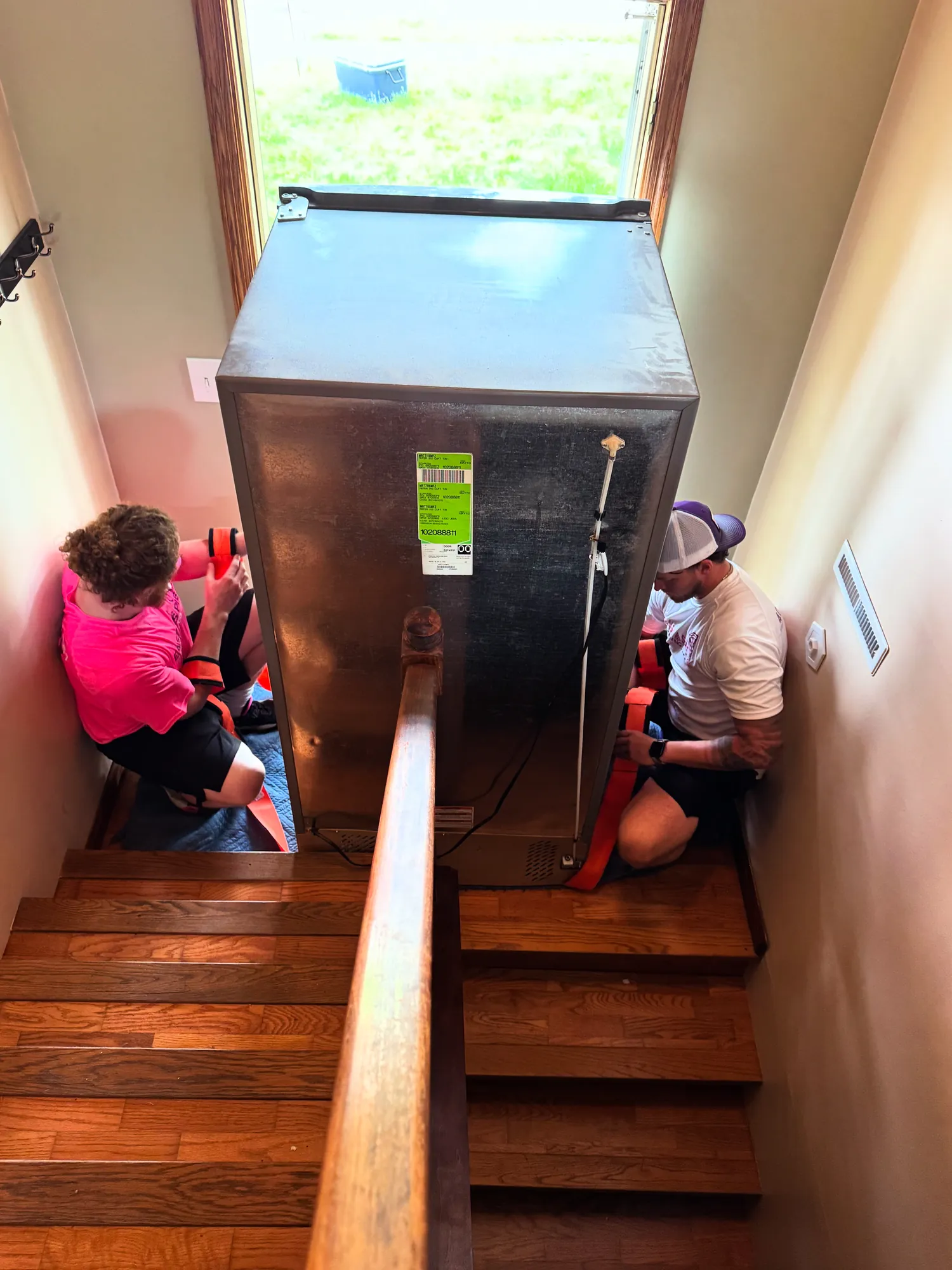
A refrigerator is one of the heaviest, most awkward things in your house, and it’s easier to damage than it looks. Tip it the wrong way, plug it in too soon or yank the water line, and you can end up with a dead compressor or a wet floor. Here’s how to move a refrigerator the right way, step by step, and when it makes more sense to hand it to movers.
Safety First
Before you touch the fridge:
- Get help. You need two people, minimum. Three is better for stairs.
- Know the weight. Look up your model’s weight in the manual or spec sheet. Whirlpool recommends a dolly rated for the appliance’s weight, with straps.
- Wear closed-toe shoes and gloves with grip.
- Never get below it alone on stairs. If the fridge gets away from you, you don’t want to be the thing that stops it.
Step 1: Find Your Owner’s Manual
Moving advice changes from brand to brand and even model to model. For example, GE says its French-door, bottom-freezer and compact refrigerators must always stay upright. Your model number is usually on a label inside the fridge, and most manuals are free online.
Step 2: Empty, Defrost and Clean (1 to 3 Days Ahead)
- Turn off the ice maker early. Whirlpool says to shut it off and toss the ice two to three days before you move, and to shut off the water supply at least a day ahead.
- Eat down the food. Move what’s left in a cooler with ice. The FDA says your fridge should be at 40°F or below and your freezer at 0°F, so plan to keep perishables cold until the fridge is back to temperature.
- Defrost the freezer. Whirlpool’s appliance moving guide says to allow at least 6 to 8 hours. Unplugging it the day before gives it plenty of time. Put towels down to catch the water.
- Clean and dry everything. Any moisture left inside can turn musty on the trip.
Step 3: Disconnect the Water Line
If your fridge has an ice maker or water dispenser:
- Shut off the water supply valve.
- Disconnect the line at the back of the fridge the way your manual describes.
- Catch drips with a towel and tape a bag over the end of the line.
If you’re not comfortable doing this, call a plumber or appliance tech. A bad reconnection can leak behind the fridge for weeks before anyone notices. Our crews don’t disconnect or reconnect water lines, so plan to have that done before the move and after the fridge is in place.
Step 4: Secure Everything Inside and Out
- Take out glass shelves and drawers. Wrap them in towels or packing paper and pack them in a box so they can’t rattle and crack.
- Tape the doors shut with stretch wrap or tape that won’t pull the finish.
- Tape the power cord to the back of the fridge so nobody trips on it or rolls over it.
- Wrap the outside in moving blankets.
Step 5: Measure Every Doorway and Turn
Measure the fridge (height, width and depth), then measure every doorway, hallway and stair turn on the way out and on the way in. Leave room for the dolly and your hands.
Too tight? Many refrigerator doors come off. Follow your manual, bag the hinge screws and tape the bag to the fridge. Don’t forget the opening in your new kitchen, either. Moving into a walk-up? Read our tips for buildings with no elevator first.
Step 6: Protect the Floor and Pull It Straight Out
Lay down cardboard or hardboard in front of the fridge. Whirlpool says to pull it straight out and not to wiggle or “walk” it. Walking a fridge side to side is how floors get scratched.
Step 7: Use an Appliance Dolly
A regular hand truck isn’t built for this. An appliance dolly has a strap to hold the fridge on, and many have treads made for rolling up and down stairs.
- Load from the side. Tilt the fridge slightly to one side and slide the dolly underneath. Whirlpool warns not to tilt it forward onto the dolly.
- Strap it tight.
- Tip it back no more than 45 degrees.
- Go slow on stairs. One person works the handle and controls the weight while a helper guides from the other end, one step at a time.
Step 8: Keep It Upright on the Truck
Lowe’s puts it simply: never lay a fridge on its front or back, because it can damage the coils and cooling system. Stand it up in the truck and strap it to the wall so it can’t tip or slide. Some models can ride on one specific side if there’s no other way. Your manual will tell you which side, if any.
Step 9: How Long to Wait Before Plugging It Back In
This is where the internet gets confusing, and for good reason: the answer really does vary by brand and by how the fridge traveled. The worry is the compressor oil. LG explains that tilting can make oil flow where it shouldn’t, and powering on too soon can cause a malfunction.
Here’s what the big brands say on their own support sites (as of 2026):
| Brand | What the brand says |
|---|---|
| GE | If it rode on its side, stand it up for as long as it was down. If it was on its side for more than a day, wait 24 hours. |
| Samsung | Moved upright: wait at least 2 to 3 hours. Moved on its side: stand it up and wait at least 4 hours. |
| LG | Moved within your home: about 5 minutes. Moved lying down: one LG article says about 2 hours upright, another says 24 hours. |
| Whirlpool | Keep it upright. If it had to be laid down for an extended time, wait 24 hours before restarting. |
The safe takeaway: follow your manual first. If you can’t find it, a fridge that stayed upright the whole way needs only a short rest, and a fridge that spent time on its side should stand upright at least as long as it was down, up to a full day. Waiting longer costs you nothing. A ruined compressor costs a lot.
Step 10: Plug In, Reconnect and Wait to Restock
- Level the fridge so the doors close on their own.
- Reconnect the water line and check it for drips over the next day.
- Give it time. GE says it takes about 24 hours for a refrigerator to reach a stable temperature, though you should feel some cooling in the freezer within about an hour.
- Put an appliance thermometer inside and restock once it reads 40°F or below.
When to Hire Movers for Your Fridge
A fridge is doable yourself on a flat path with a good dolly and a strong friend. Call in help when:
- There are stairs at either home
- It’s a big French-door or built-in model
- The path has tight turns or doors that need to come off
- You don’t have a dolly, a truck with straps or two able helpers
- It’s part of a whole-house move anyway
Our crews pad every piece, strap every load and flag awkward items like refrigerators before they touch them. We’ll handle the fridge as part of your local move, or book our moving labor service if it’s the only heavy thing you need moved. Every one of our trucks carries three dollies and forearm straps for heavy pieces like this. For everything else that week, use our complete moving checklist.
Refrigerator Moving FAQs
Can you lay a refrigerator down to move it?
Upright is always best. Never lay a fridge on its front or back. Some models can ride on one specific side if there’s no other option, but others, like GE’s French-door and bottom-freezer models, must stay upright. Check your manual.
How long after moving a refrigerator can you plug it in?
It depends on the brand and how it traveled. Brand guidance runs from a few minutes for a fridge that stayed upright to 24 hours for one that spent a long time on its side. Follow your manual first.
How long does a refrigerator take to get cold after moving?
GE says about 24 hours to reach a stable temperature. Keep food in a cooler until an appliance thermometer reads 40°F or below.
Do I need to defrost the freezer before moving?
Yes. Whirlpool recommends at least 6 to 8 hours. Unplugging it the day before gives it time to defrost and dry out.
Let Us Handle the Heavy Stuff
At Easy As Pie Moving Co., our crews call when they’re on the way, walk every room with you and pad and strap every load, fridge included. No stair fees, and your moving agreement arrives when you book.
Request your free estimate or call us at (402) 200-4661.
